The Quietest Long-Range Business Jets Ranked by Cabin Noise
August 26, 2026
Business jet users have a vested interest in researching the cabin noise of the planes they use, and internal ambient audio levels matter for comfort and productivity purposes alike. Moreover, high-net-worth individuals and executives who fly private regularly need this information to hand, whether they’re opting for outright business jet ownership or considering leasing deals.
Long flights with high-frequency, high-volume interference created by engine noise and turbulence can be a mental burden that limits clear thinking and prevents rest. Evaluating cabin noise levels in decibels (dB) and speech interference level (dB SIL) is possible using the official data provided by business jet manufacturers and third parties.
BlackJet, a private jet card program operator, compiled a ranking of the quietest long-range business jets by cabin noise.
Understanding Speech Interference Levels at High Altitude
Acoustic engineering in long-range aviation relies on SIL ratings to quantify cabin quietness. Standard commercial airliners operate with cabin ambient sound levels between 75 dB and 85 dB.
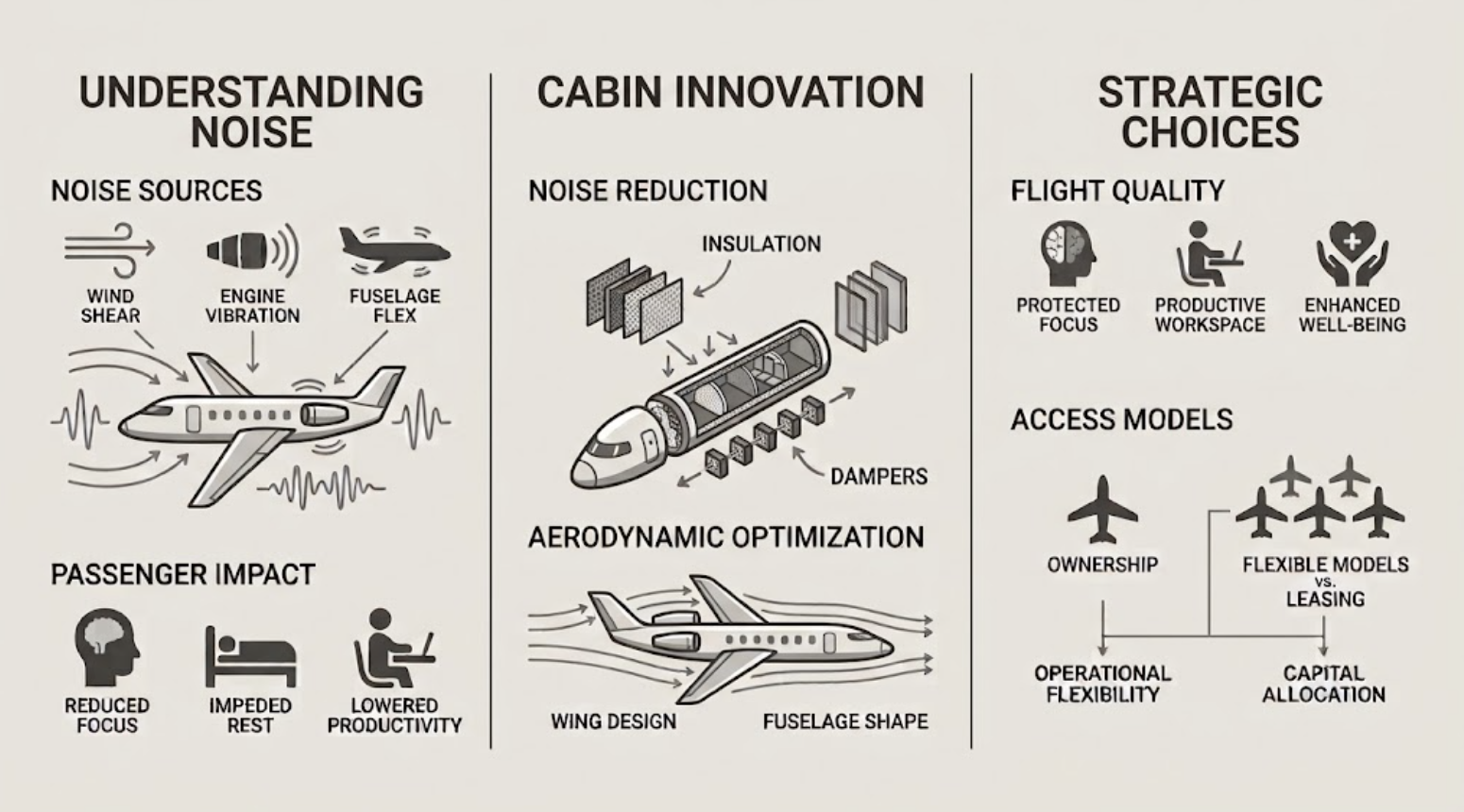
By contrast, modern long-range business aircraft target acoustic thresholds under 50 dB SIL, which mirrors a quiet corporate conference room. Engineers achieve these suppressed decibel levels through targeted structural and aerodynamic interventions.
Soundproofing packages integrate up to 600 pounds of specialized multidensity acoustic foam.
Tuned mass dampers placed along fuselage bulkheads absorb low-frequency engine resonance.
Because the decibel scale is logarithmic, a reduction of just 3 dB cuts the sound energy reaching the cabin in half. This distinction means a 47 dB cabin is vastly quieter than a 50 dB cabin over long-haul flight routes.
Ranking the Quietest Long-Range Business Jet Cabins
Topping the acoustic rankings among ultra-long-range platforms is the Gulfstream G700, registering an internal cabin noise floor as low as 47.6 dB SIL during high-speed cruise. Gulfstream accomplished this acoustic benchmark by pairing sound-insulating sidewall treatments with aerodynamic design refinements across its wing roots and fuselage skin. Figures will vary depending on the materials and layout specified by customers, but it’s an impressive starting point.
Sitting in the middle of the top tier is the Dassault Falcon 10X, engineered to maintain cabin sound levels under 50 dB SIL. Dassault leverages active acoustic dampening techniques and advanced composite structural panels to isolate aerodynamic thrum from the executive workspace. It also boasts updated aerodynamic properties that reduce external drag, meaning more of the cabin can enjoy lower ambient noise levels, rather than just a few select areas.
The Bombardier Global 7500 closely follows, logging an ambient cabin sound profile of 50 dB SIL in Fly Victor testing. Some sources cite this at 48 dB SIL, although since no official figures are available, it’s safer to go with the only third-party data that makes a firm statement from firsthand experience. Bombardier achieves this quiet environment through the integration of General Electric Passport engines alongside dedicated acoustic bulkheads separating the primary seating zones from the forward galley.
The Real Effect of Cabin Soundproofing
Despite business jet manufacturers being cagey about cabin noise levels, it’s safe to assume that the claims made by these top-tier manufacturers are close to the reality that passengers can expect. And given that the difference between 47 dB SIL and 50 dB SIL will be largely undetectable to most people, with Fly Victor equating it to the hum of a domestic refrigerator, choosing a plane on this metric alone is not necessary if you’re committed to selecting from the highest rungs of the market as it stands.
Outright ownership is not always the right choice. Securing an ultra-quiet cabin environment requires analyzing how airframe acquisition and operational costs align with corporate flight volume. While ultra-long-range aircraft deliver peak acoustic performance, full ownership requires substantial capital allocation and ongoing maintenance commitments.
According to the National Business Aviation Association, full aircraft ownership generally makes financial sense only when annual flight time exceeds 250 flight hours. For corporations flying fewer hours, committing millions to a single depreciating asset creates capital inefficiency. To maintain acoustic comfort without absorbing full asset risk, many corporate flight departments evaluate flexible options like fractional programs or long-term leasing. These structures let corporations treat flight operations as an operating expense while maintaining access to low-decibel, long-range aircraft.
Strategic Aircraft Selection for Corporate Leadership
When evaluating long-range airframes, decision-makers must weigh cabin sound levels alongside traditional metrics like range, speed, and airport performance. Reducing low-frequency acoustic exposure directly protects passenger focus, enabling executives to step off a trans-Atlantic flight fully prepared for negotiations. There’s no wrong choice in the upper echelons of the market from an acoustic perspective, but thorough research on aspects like fuel efficiency and range is still necessary.


 Regístrate con Google
 Regístrate con Apple