The Hidden Cost Of Waiting Until The Last Minute To Book A Private Jet
July 24, 2026
Last-minute private aviation bookings impose predictable cost penalties that erode quarterly travel budgets. When corporate treasurers wait until the final days to confirm flights, they surrender pricing power to the market.
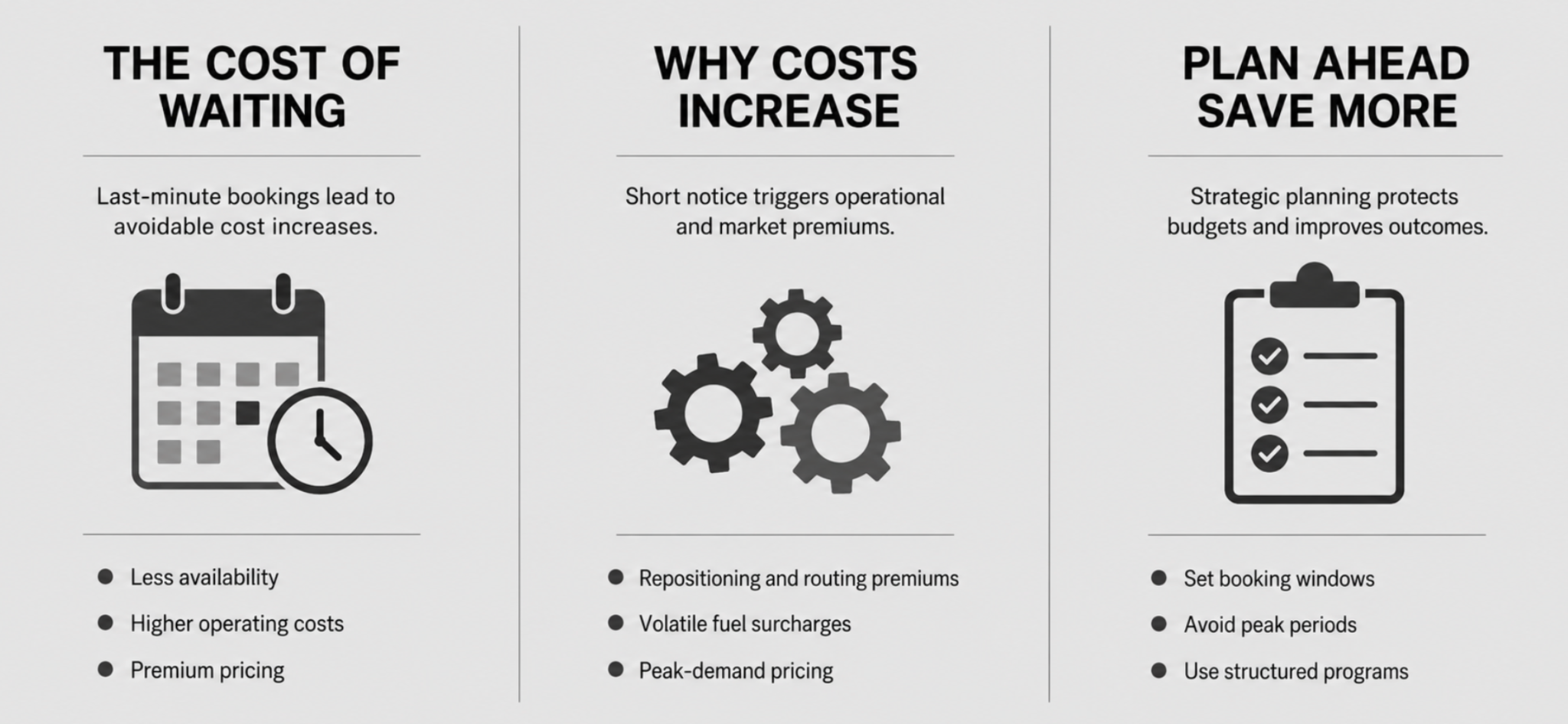
Empty repositioning legs, fuel surcharges, peak-window premiums, and dynamic pricing all compound into single-booking costs that spike far beyond early-booking rates. As BlackJet, a private jet card provider, explains below, delayed decision-making becomes a material line-item expense.
That pressure intensifies as global flight activity rises. The ARGUS TRAQPak 2026 Forecast projects flight volume will grow 1.9% this year, pushing fleet utilization to historic highs and amplifying the cost penalty for short booking lead times. For organizations managing executive mobility across multiple markets, the difference between a seven-day booking window and a 24-hour confirmation now translates directly to capital efficiency—or lack thereof.
How Ferry Legs Inflate Last-Minute Costs
Private aircraft don't sit idle at departure airports. A last-minute booking forces operators to execute empty ferry legs—moving an airframe into position costs money the booker absorbs entirely.
Elevated dynamic operating costs are an issue across the industry, with volatile fuel prices imposing steep premiums on short-notice flights and single-leg routing adjustments due to fuel surcharges and immediate repositioning demands. As reported by the Guardian, industry body IATA expects fuel alone to become 70% more expensive this year, creating $100 billion in additional costs that airlines of all kinds, including private operators, must swallow.
Moreover, the increase in insurance premiums for private jets, which now average between $100,000 and $500,000 annually, according to Research and Markets, further inflates the operating expenses of aviation organizations. There’s thus less of an incentive to offer the best prices to last-minute bookers, because in times of such volatility, it’s better to incentivize customers who plan well in advance and create a base of stable income, rather than penalizing them with higher prices. While 51.62% of the market’s revenue was made up of these last-minute bookings last year, this is more of a benefit for operators than passengers.
Those who book early will be able to access prices that are not as impacted by anticipated operational cost increases. For a corporation frequently moving executives between regional offices, these unforced routing premiums rapidly degrade quarterly travel efficiency.
Private jet passengers who crave the convenience and flexibility of this mode of transport must still recognize the realities of the market as it stands, which means planning for hidden costs that can come with last-minute booking.
The financial penalty of short-notice booking intensifies during high-demand periods. When corporate travel coincides with major trade shows, international forums, or holiday weeks, the available fleet capacity drops to near zero.
Confronting a saturated market with limited lead time alters the core quote structure. Industry tracking from ACC Aviation and reported by Airline Economics indicates that flights spike by 70% during high-demand windows, meaning fleet capacity is stretched thin by short lead times and prices inevitably rise as well. A delayed booking window during these periods guarantees peak asset pricing.
Ad hoc bookers who bypass structured programs take on significant fuel price risk. Data from IATA reveals that fuel accounts for 25% to 30% of direct hourly operating expenses, creating volatile spot pricing liabilities for ad hoc bookers who lack fixed-rate contractual protection. When booking weeks in advance, operators can hedge routing costs, but a 24-hour-notice flight forces the buyer to swallow the exact spot fuel price that is in effect at the local fixed base operator.
Managing these compounding variables requires a shift in corporate travel policy. A disciplined booking workflow protects cash reserves and prevents predictable cost inflation.
The operational math favors organizations that prioritize lead time over eleventh-hour scheduling changes. Incorporating three specific protocols can insulate an aviation budget from unnecessary market premiums.
Implementing a mandatory seven-day booking window for standard domestic regional routes
Shifting non-urgent executive travel away from known peak holiday infrastructure constraints
Utilizing structured booking programs to lock in predictable hourly operational caps
How Planning Windows Lock in Predictable Costs
Mitigating last-minute cost spikes does not require corporations to sacrifice the operational agility that makes private aviation valuable. It requires a clear framework that separates true emergency dispatches from systemic scheduling procrastination.
Preserving cash reserves relies on treating private travel as an optimized operating expense. When flight departments give operators a wider fulfillment window, the marginal cost per flight hour drops significantly. This simple operational adjustment allows businesses to preserve cash reserves for core investments while still extracting the maximum productivity benefits out of their private aviation spend.


 Regístrate con Google
 Regístrate con Apple