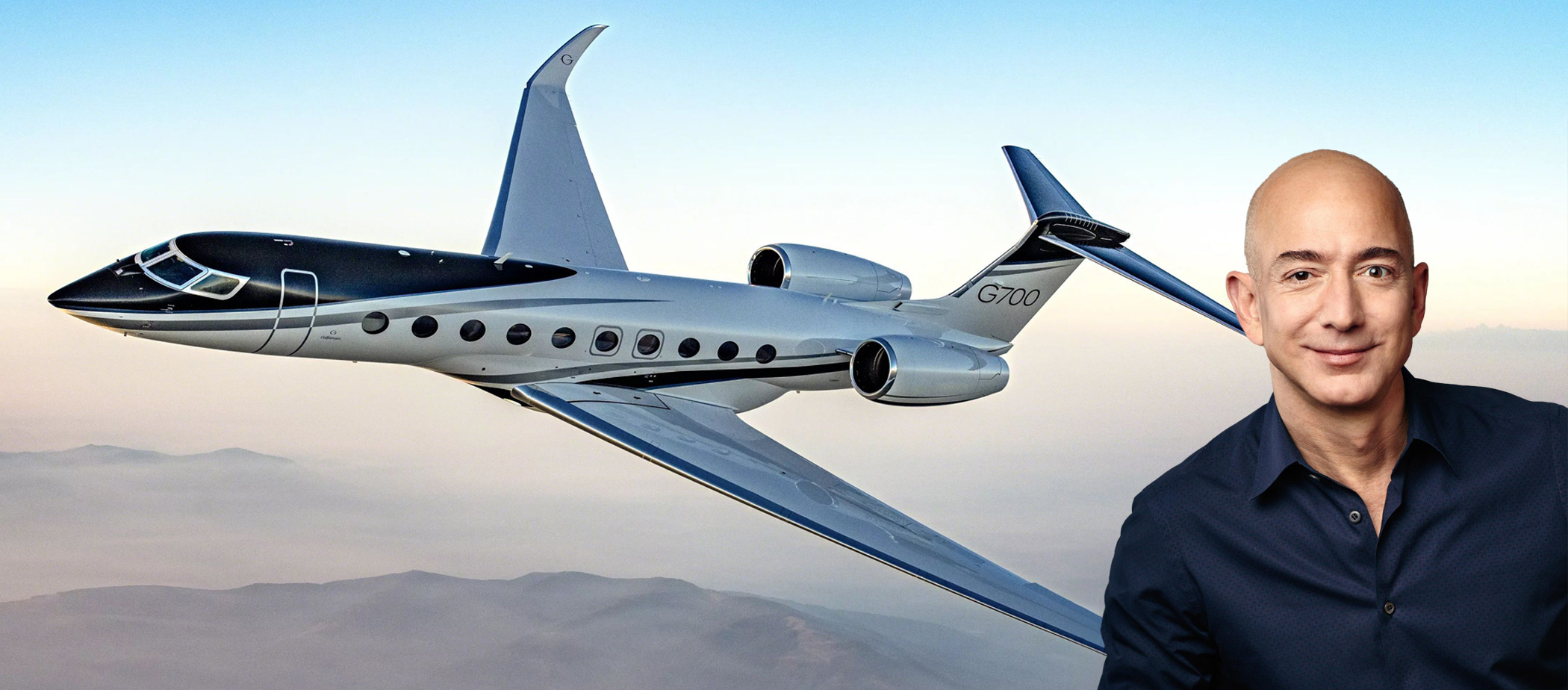
Executives managing multinational portfolios face a hard constraint: Long-range travel degrades decision-making capability. The standard commercial or legacy corporate aircraft approach stretches intercontinental transit into 13-plus hour ordeals, forcing C-suite leaders to negotiate high-stakes transactions while fatigued or defer critical choices until after landing.
The result is measurable—slower deal velocity, compressed windows for market entry, missed acquisition targets, and competitive lag in time-sensitive environments. When Jeff Bezos acquired an $80 million Gulfstream G700 in 2024, he wasn't purchasing a status symbol. He was solving a performance problem that costs enterprises millions in lost momentum.
Real-time positioning matters. Timezone differences no longer excuse delayed decisions. Executives managing multiple markets now demand aircraft that compress travel time, not extend it.
As BlackJet, a private jet card company, explains below, evaluating how these advanced airframes operate under heavy use means financial decision-makers can reframe travel from an administrative overhead expense to a clear competitive accelerant.
How Cabin Pressurization Cuts Negotiation Fatigue
Transoceanic transit can exhaust executives, potentially degrading their ability to negotiate. The G700 cut travel time down with twin Rolls-Royce Pearl 700 engines capable of Mach 0.935—cutting a standard 12-hour intercontinental flight down to roughly 11 hours.
The cabin maintains a 2,840-foot pressurized altitude at cruise, mirroring sea-level conditions—low enough that cognitive fatigue drops measurably. An advanced plasma ionization system continuously refreshes oxygen levels, helping prevent the mental fog that might set in on long-haul flights.
When combined with a specialized circadian lighting matrix that simulates changes in dawn and dusk based on the regions being traveled from and to, the platform systematically neutralizes jet lag before the aircraft lands. Executives can step directly from a long-range international leg straight into high-stakes negotiations without requiring a standard hotel recovery buffer.
Accommodating Backlogs and Future Procurement
The expanding ecosystem of ultra-long-range travel has driven unprecedented demand, resulting in extended manufacturer backlogs stretching out multiple years. This supply constraint forces corporate flight departments to look beyond traditional factory orders to maintain global mobility.
Decision-makers must balance the desire for a customized cabin environment against the immediate operational necessity of global mobility. For those who cannot afford to wait years for a direct factory delivery, alternative access models offer an immediate solution. Entering the market through structured leasing arrangements allows corporations to deploy these advanced capabilities without long procurement delays.
The choice of procurement method determines how fast an organization can enter new markets. While outright ownership offers total control over the physical asset, it binds corporate capital to a single airframe. Flexible fleet access ensures that a corporation remains nimble, matching specific aircraft capabilities to changing corporate transit requirements.
Capital Optimization in the Access Economy
Whether an organization deploys ultra-long-range platforms depends on a single question: What drives competitive advantage? Speed, environmental controls, and global reach transform these aircraft from luxury assets into genuine force multipliers for leadership teams.
For the modern enterprise, the true luxury is the systemic conquest of geographic distance and human fatigue. Organizations able to adapt to this new standard will be better positioned to outpace competitors constrained by legacy transit models.


 Regístrate con Google
 Regístrate con Apple